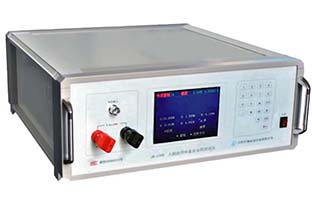
The tester is manufactured in accordance with therelevant provisions of the national standard GB/T3048-2007 Test methods for electrical properties of electric cables and wires – Part 4: Conductor DC resistance test, and with reference to Part 2: Test of electrical resistivity of metallic materials. It is mainly used for testing of DC resistance of large cross-section conductors, and can also be used independently as 100A (up to 120A) DC standard source, consisting of a 0.05-level DC standard source, a resistance drop measuring plate and a control single chip.
The measuring plate uses C8051F350 single chip, including a 24-bit ADC. Integral non-linearity of ADC is± 15ppm FS (full-scale value), and after calibration, the gain error is ± 0.002%.
The display uses a 5.7”color LCD, and charts and characters are displayed clearly.
Main Technique Specification
Main Functions & Features
A four-point method is used for measurement. Known current I is provided by a standard source, which flows through the current terminal of Rx conductor to be tested, and the potential terminal of the conductor (the specified length is typically two end points of 1m) is connected to the measuring plate. In the case that the amplification factorK of the measuring voltage remains unchanged, UI and U
Where, when I= 0, U
After the cross-sectional area (mm 2) of conductor Rx to be tested is input, the instrument can automatically select an appropriate current in order to ensure accuracy of measurement and to give a result of the measurement; if re-measurement is needed after measurement, the tester will be started for further measurement.
For a conductor with extra large cross-section <10 μΩ, rough measurement may be made in the range 10μΩ- 20μΩ, and the result helps determinate the length required for compliance with 10μΩ.
If the cross-sectional area is not known, the instrument can automatically select the appropriate current from 0.5A, provided that the measurement time is longer. Note: When the cross-section is small, a conductor, through which 0.5A current is not allowed to flow, cannot be measured with this instrument.
The instrument is equipped with a temperature - digital transducer, and in the range of 5℃- 35℃, the measurement error can be ≤ 0 .25℃ (data from the manufacturer). Able to communicate with the host of the instrument, the transducer can be used to measure the ambient temperature and Rx conductor surface temperature.
Copyright www.julywell.com All rights reserved JUWEIKEJI
赣ICP备 06002063号